Nuclei
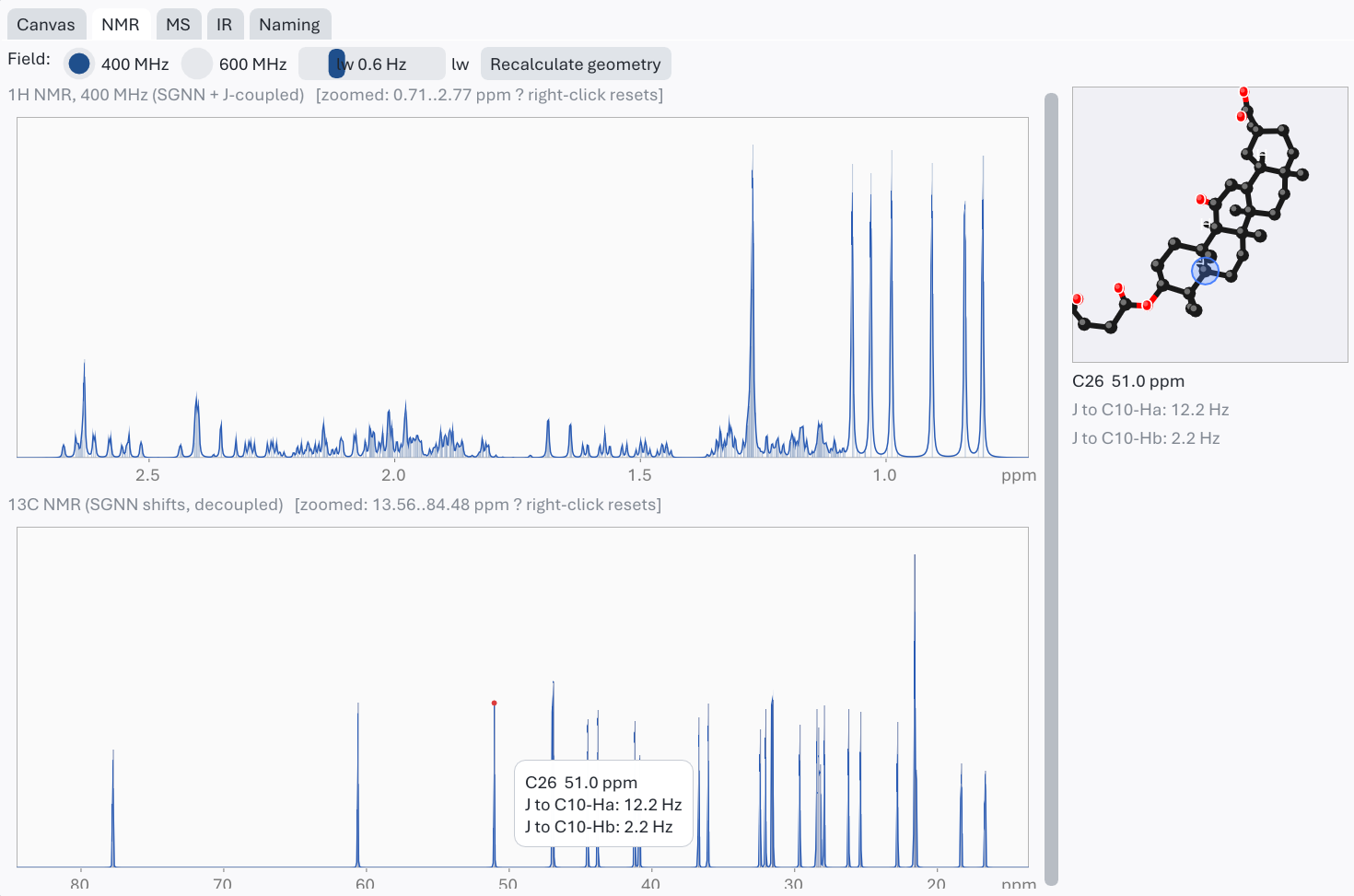
¹H, ¹³C, ¹⁹F, ³¹P shifts. nJHH, nJFH and nJFC couplings.
 ChemGraf
Native C++ · offline · in development
A chemical drawing program with the prediction stack inside it, instead of behind a server.
The editor is free, forever.
Your molecules never leave the machine.
Or draw one in your browser — the editor itself, running in the page. Nothing to install, nothing uploaded.
Everything runs locally. No account, no server round trip, no structure leaving your network.
Every shipped model is either permissively licensed or trained here from scratch on licence-checked data.
Dependency-light and statically linked. Install and run on any machine. No more python venvs.
Why ChemGraf
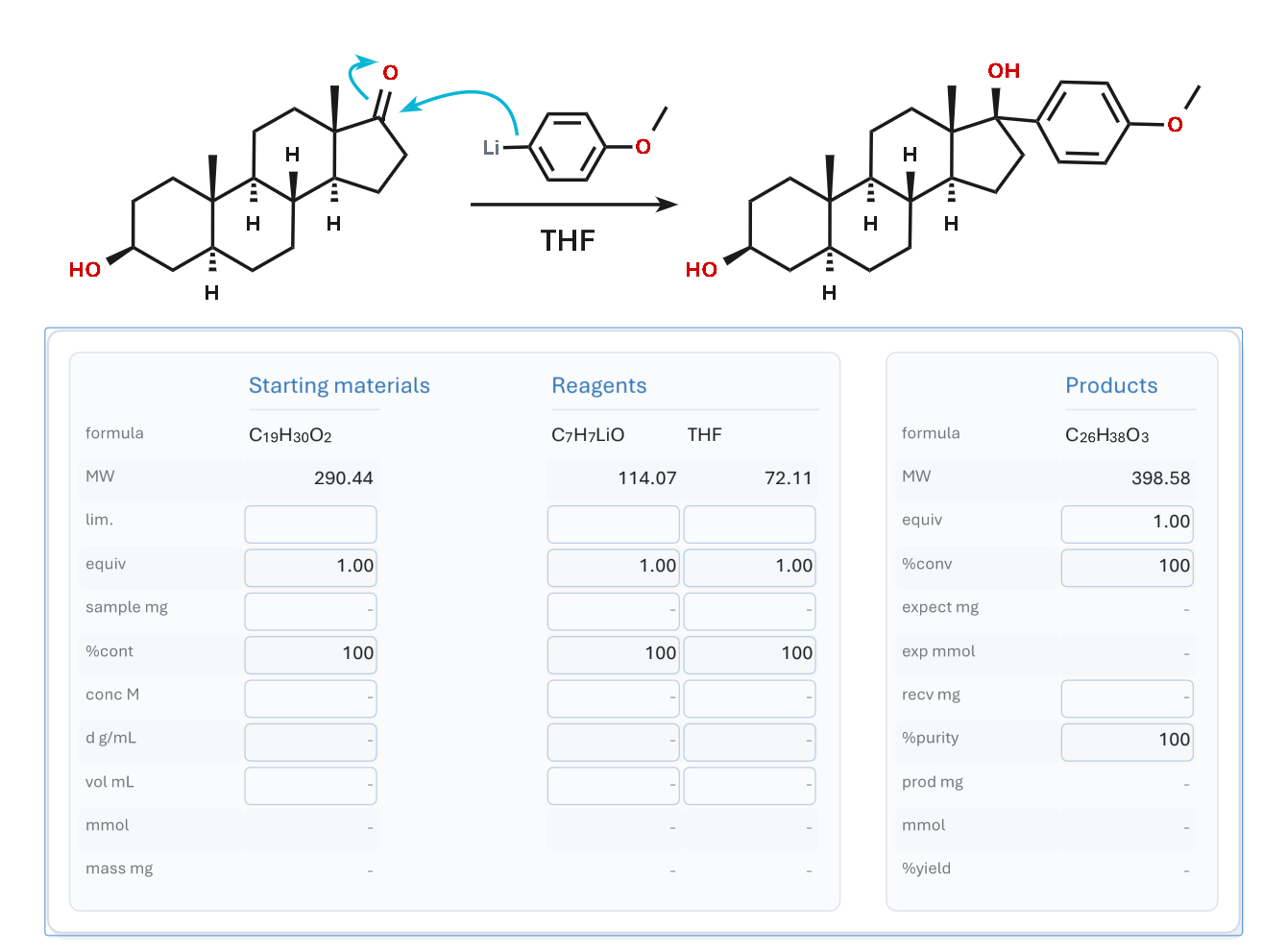
Free drawing programs you can install and keep are disappearing. What is left is a browser tab, a paid seat, or a toolkit that wants Python first. ChemGraf puts that kind of program back on the desktop: publication-grade drawings and spectra, nothing uploaded.
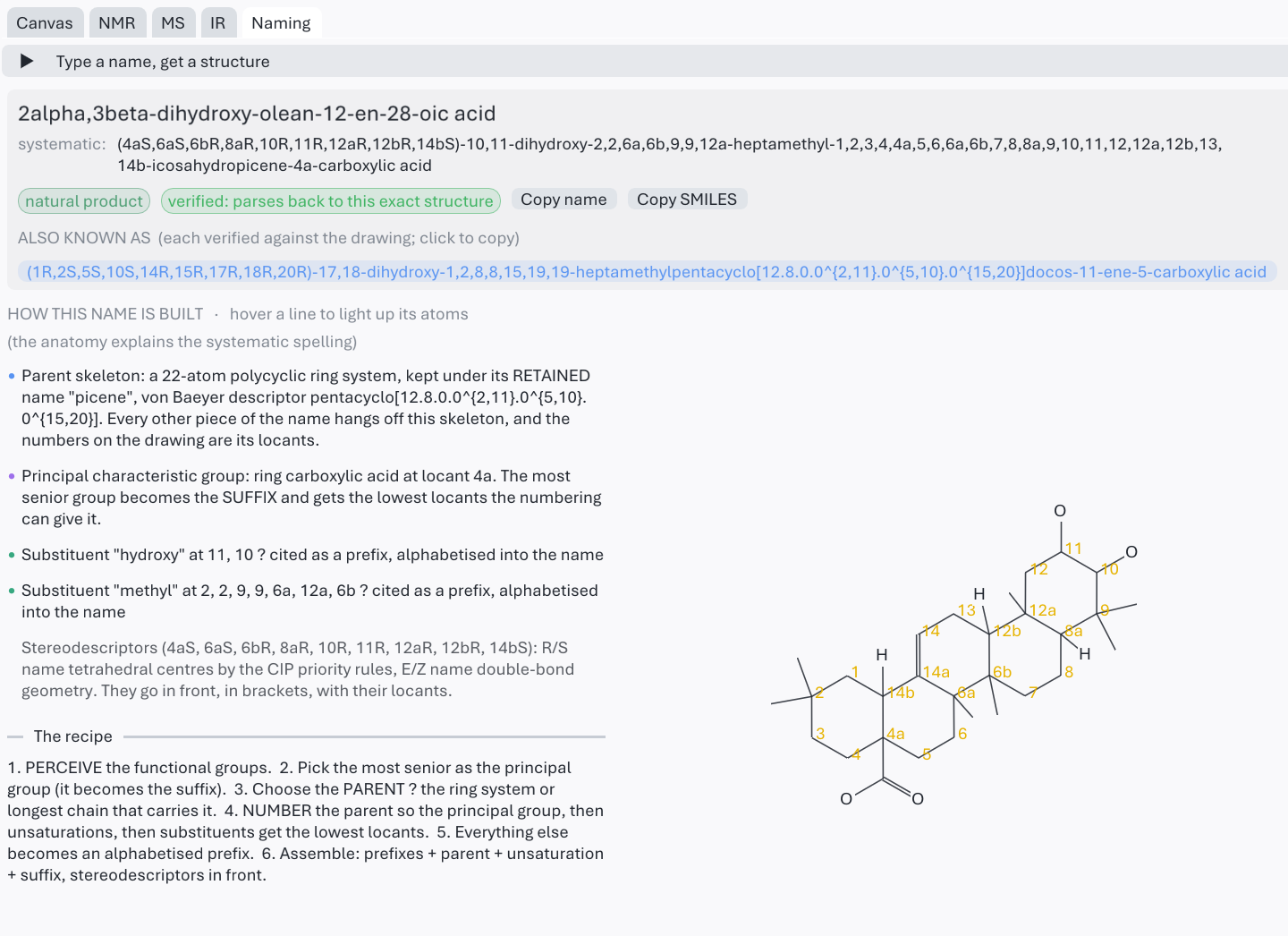
The editor is free and stays free: the whole drawing surface, the file formats, IUPAC names in both directions. No watermark, no account, no expiry.
The paid version adds the prediction stack and 3D conformers informing the spectra: a single payment with a lifetime licence, no subscription.
What is in it
Drawing is free. The reason to buy is what happens after you draw — and all of it runs on your own machine.
¹H, ¹³C, ¹⁹F, ³¹P shifts. nJHH, nJFH and nJFC couplings.
Spin systems solved by exact diagonalisation, not additivity rules. A quartet is a quartet because the maths says so.
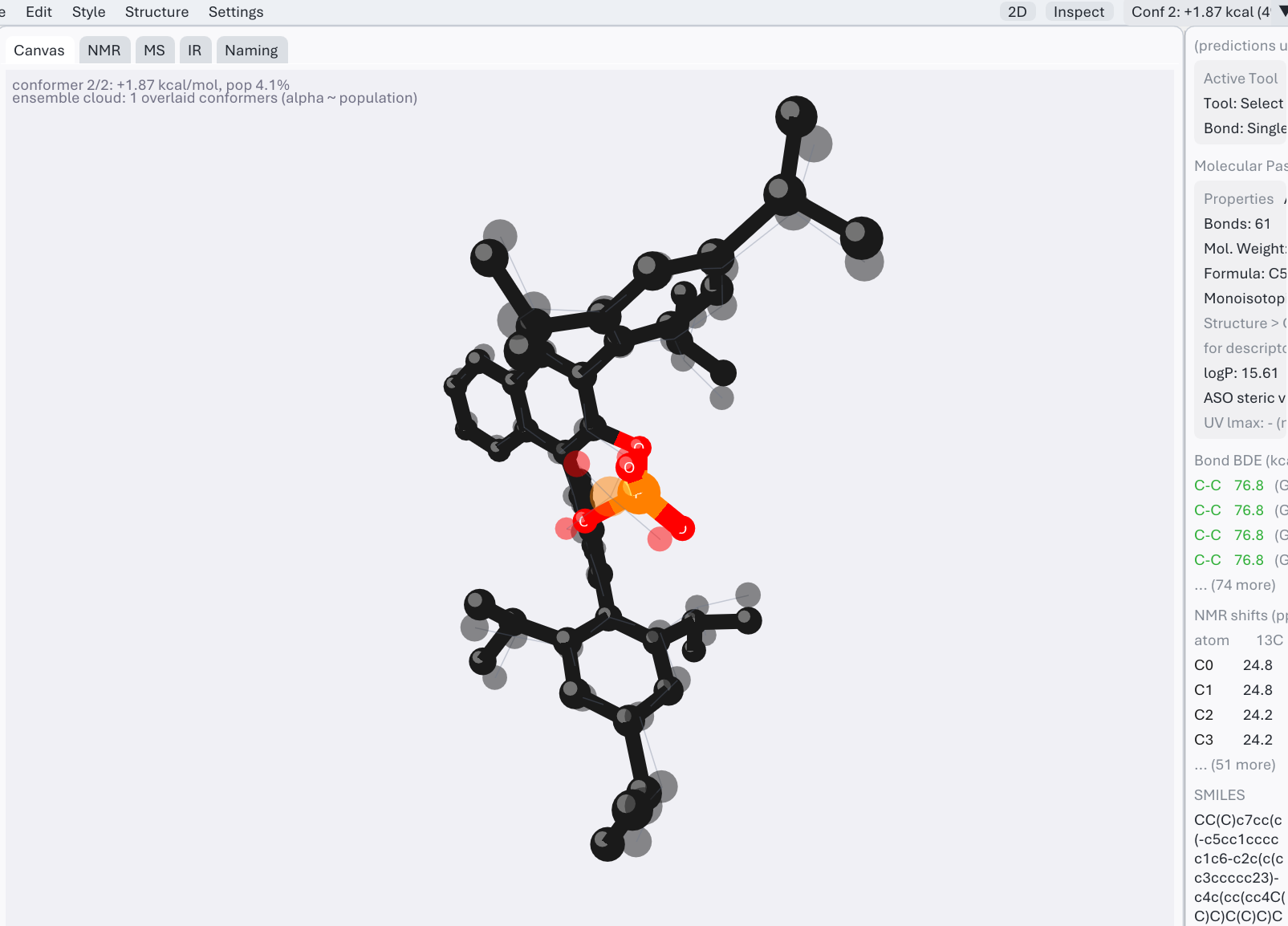
ETKDG embedding and MMFF94s optimisation in the editor. Boltzmann-weighted ensembles feed the spectra.
Own model, trained in house. Conformer-averaged rather than single-geometry.
EI fragmentation and ESI-MS/MS, with bond dissociation energies informing the fragments.
pKa from rules, a GNN and Taft corrections. logP, molar refractivity, BDE, UV/Vis rules.
ASO and AEIF occupancy and charge vectors, pose-invariant, dumped as plain arrays.
QED, synthetic accessibility, PAINS / Brenk / NIH / ZINC filters, Lipinski, Veber, Ghose, Egan, Muegge.
The stack is the living half of the program. New property and reactivity predictions are added as they become available.
Free and paid
No trial, no cut-down demo: the free version is the same editor the paid one is built on.
ChemGraf
Free · forever · no account
The complete structure editor. Everything you need to draw a molecule and put it in a document.
Part of this — the drawing surface, without the naming — already runs in a browser tab: try it now.
ChemGraf Pro
One payment · lifetime licence
Everything above, plus the prediction stack. Buy it once, at a price aimed at individuals rather than institutions.
Two promises in writing. File formats will never move behind a paywall. And a lifetime licence means the copy you bought keeps working: no server call to check, so nothing can switch it off later.
The program
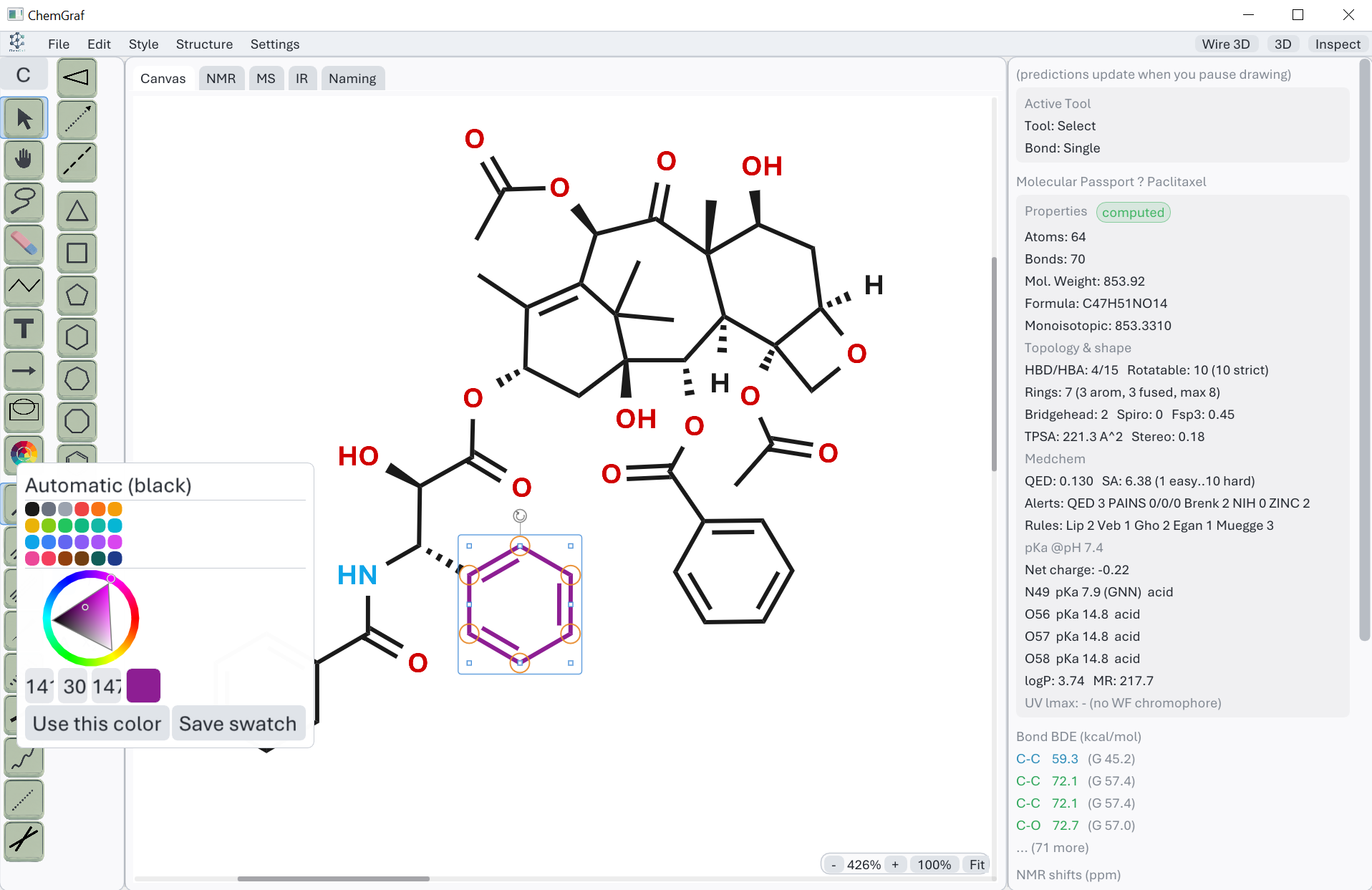
Screenshots of the program as it stands today, not mock-ups. Light and dark themes, a resizable tool strip, and an info panel that keeps the numbers next to the drawing.